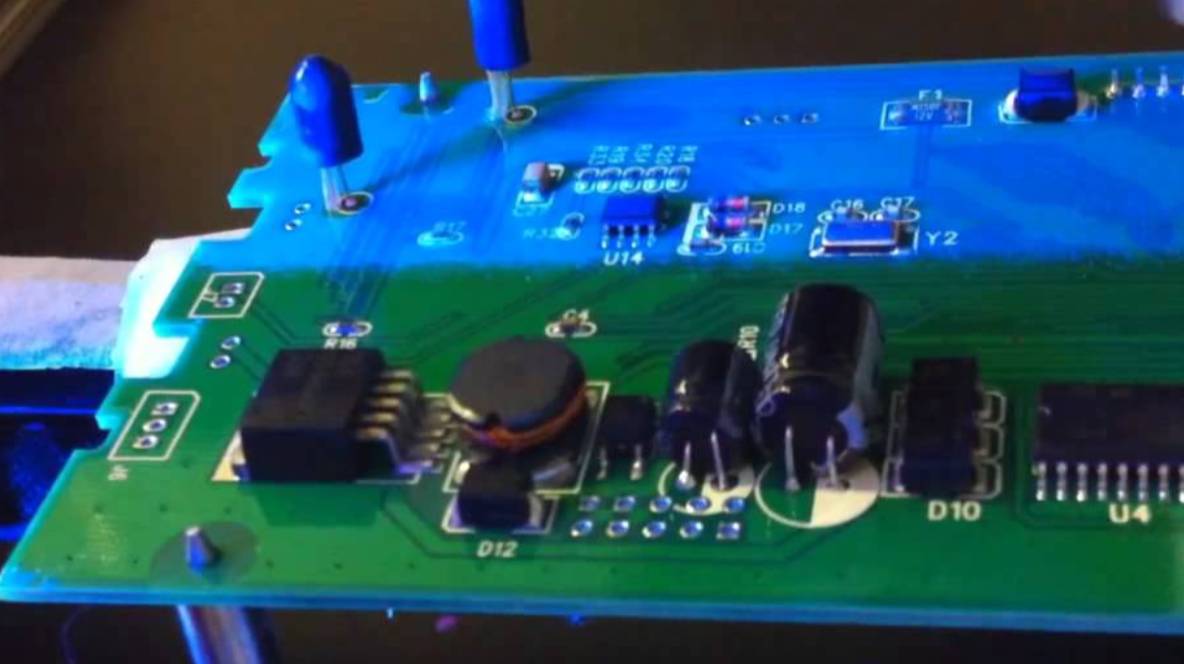
Black Opaque Conformal Coating for PCB Security and Light Control
On many assemblies the conformal coating does a second job beyond environmental protection: it hides the circuit from view and stops stray light from reaching a sensor. A pigmented, opaque UV-curable coating handles both while still sealing the board against moisture. Two problems a clear coating cannot solve A transparent conformal coating leaves the circuit fully visible. Anyone who opens the enclosure can read part markings, trace the routing, and photograph the layout, which lowers the barrier to cloning or reverse-engineering a design. A clear film also reflects and transmits light. On a board that carries an optical sensor, a camera module, or an infrared receiver, that internal light scatter raises the noise floor and degrades measurement accuracy. An opaque black coating addresses both. The pigment blocks visible and near-infrared light, so the circuit detail is obscured and internal reflections are suppressed. The film is also built thicker than a typical clear coating, adding a layer of abrasion and impact resistance. Incure's Ultra-Illumina™ opaque UV conformal coatings provide this combination: a matte-black, light-blocking film that cures in seconds under UV light and still functions as a moisture barrier. Properties Opaque black finish: conceals traces, part numbers, and layout; absorbs stray internal light in optical assemblies Thick, resilient film: resists the scratches and knocks of assembly and service Moisture and contaminant barrier: protects against humidity, condensation, dust, and the corrosion they cause 100% solids: predictable cured thickness, no solvent flash-off, no VOC handling Flame-retardant: contributes to the finished product's fire rating Recognized to UL: supports assembly listing Strong adhesion: holds through thermal cycling and vibration Curing a pigmented film Black pigment absorbs UV energy, so a purely light-driven cure would harden only the top surface of an opaque coating. Incure's opaque UV coatings include a secondary moisture-cure mechanism: the resin below the surface, and in the shadow of tall components, continues crosslinking by reacting with ambient humidity over the following hours. That dual mechanism is what lets a thick black film reach full hardness throughout. Delivering adequate UV dose to the surface still matters. See Incure's guidance on matching a UV conveyor lamp head to line speed and part width and selecting a UV cure chamber by lamp and part size. Application and inspection Clean and dry the board; ionic residue under any coating drives corrosion. Mask connectors, contacts, and thermal interfaces. Apply the opaque coating by selective spray or dip to a uniform wet film, generally thicker than a clear-coating spec so the film is fully light-tight, then UV-cure the surface and let the assembly rest so the sub-surface resin completes its moisture cure. Because the film is opaque, coverage cannot be confirmed by a fluorescent-tracer glow. Verify with a wet or cured film-thickness gauge and inspect the board edges, connector keep-outs, and any optical windows visually. Check that the coating fully covers the areas meant to be hidden and stays clear of lenses and apertures that must stay open. Field durability The thicker opaque film buys longer moisture-ingress resistance…